Bathroom Mold Removal in North Las Vegas, NV
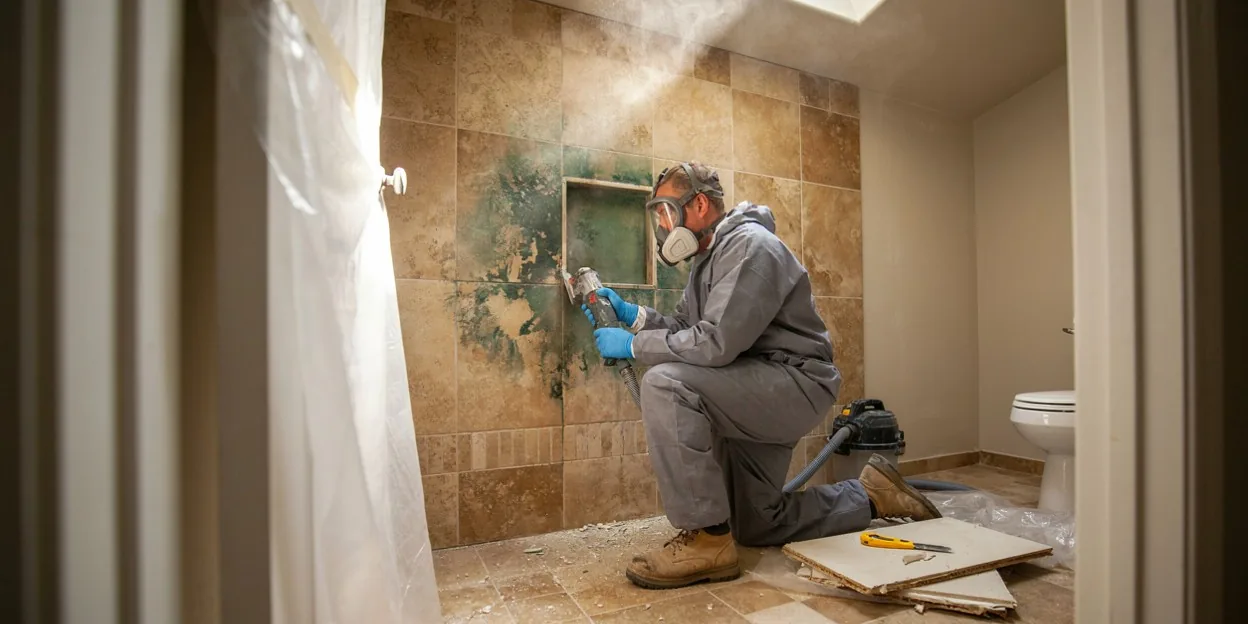
The grout at the bottom of the shower goes dark no matter how often you scrub it, and the baseboard outside the shower wall has started to swell. Last month you noticed the vanity floor is soft at the back corner where the drain comes through. This site connects you by phone with an independent local provider who does bathroom mold removal in North Las Vegas and across Clark County.
A bathroom leak is found with a meter, not a flashlight
Bathrooms have four likely leaks: the shower pan or its drain, the tile and grout where the wall meets the tub, the toilet flange, and the supply lines and P-trap under the vanity. The crew meters the wall outside the shower, the floor around the toilet, the vanity floor and the drywall behind it, and, in a two-story house, the ceiling of the room below.
That reading points to the source. A wet wall base outside the shower with a dry vanity is a pan or a grout failure. A soft vanity floor with a dry shower wall is a supply or a drain fitting. The crew does not pull a vanity to find out; they read it first.
Stop using the shower, run the fan, and leave the wall alone
Stop using the shower or tub until a plumber has checked the pan and the drain, and photograph the grout, the baseboard, and the vanity floor. Run the exhaust fan if there is one. Do not caulk over the dark grout or spray the ceiling corner; both hide the moisture and change nothing behind the surface.
If the bathroom has no fan and the growth is only on the ceiling paint and the top of the walls, say so when you call. Steam without a fan is a different problem than a leak, and the fix is smaller.
Vanity, wall base, and pan surround out; framing cleaned
Inside containment the crew removes what the meter said is wet: the vanity floor or the whole vanity, the drywall behind it to the mark, the baseboard and the wall base outside the shower, and in a pan failure, the tile and backer around the bottom of the shower. The studs and the slab stay if they read dry after cleaning. Air movers and a dehumidifier run until they do.
Growth on a ceiling under this bathroom is mold removal in the room below. A smell that lives in the vent duct from the fan is HVAC mold cleaning. Rebuilding the vanity, the wall, the tile, and the trim is mold damage repair, and the plumber's repair of the pan or the fitting comes first.
Hard water, old drains, and second-floor baths
The water in North Las Vegas is hard, and scale eats through shower valves, braided supply lines, and compression fittings years ahead of schedule. In the 1950s to 1970s block houses near Lake Mead Boulevard, the shower pan is often original and the drain is cast iron. In the two-story houses from Eldorado to the Villages at Tule Springs, the master bath sits over a bedroom or the garage, so the leak shows up as a ceiling stain below long before the bathroom looks wrong.
Many bathrooms in both eras have no exhaust fan, only a window nobody opens in July, and that is the ceiling-corner call. Nevada has no mold license; the provider represents its own training, and plumbing and tile work are licensed trades under the Nevada State Contractors Board. A pan replacement usually needs a permit through the City of North Las Vegas or Clark County, which the provider pulls.
Calling about a bathroom in North Las Vegas
Have the address, which fixture you suspect, and whether the bathroom is on the first or second floor. Say whether the ceiling below has a stain and whether there is an exhaust fan. Call (725) 353-7567.